English
 简体中文
简体中文

- June 25, 2026
How Sintered Stone Is Made: Pressing, Sintering & What Separates Quality from Budget
What Sintered Stone Actually Is
Sintered stone is made from natural minerals — quartz, feldspar, clay, and silica — fused under extreme heat and pressure without resin binders. This is the key difference from quartz (engineered stone), which uses 7–10% polyester resin. Sintered stone contains zero resin, zero adhesives. It is closer to porcelain than to quartz, but at higher density.
The process: mineral particles are heated to just below their melting point — 1,200°C to 1,300°C — at which atoms diffuse across particle boundaries and bond into a monolithic solid. The result: near-zero porosity and Mohs hardness of 6 to 7.
Step 1: Raw Material Batching
Quartz provides hardness, feldspar acts as a flux to aid fusion, clay gives the green body plasticity, and silica forms the structural skeleton. Inorganic pigments add color. Exact proportions are proprietary, but the base is typically over 90% natural mineral content.
Lower-grade manufacturers reduce quartz content and use lower-purity clay and feldspar. This cuts hardness, stain resistance, and thermal performance — invisible in the finished slab, only detectable through physical testing.
Step 2: Pressing — Why Pressure Matters
The mixed powder is compacted in a hydraulic press into a "green body" — a fragile, unfired slab. Industry sources indicate at least 25–30 MPa (approximately 30,000 metric tons across a standard bed) is needed for adequate compaction. Presses under 20,000 tons leave voids that become permanent after sintering — no kiln time can close a pore that was never compacted. The green body density sets the ceiling for finished slab density.
Roller presses rated at 4,200+ tons are standard for premium lines. When sourcing, ask for MPa rather than raw tonnage — 30,000 tons across a 1600×3200 mm bed delivers different pressure than the same tonnage across a smaller format. Standard slab formats range from 1200×2400 mm to 1620×3240 mm.
Step 3: Sintering — Kiln Temperature Decides Performance
The green body travels through a continuous roller kiln over one to two hours. The critical parameter is peak temperature. Published industry sources cite 1,200°C as the threshold:
| Peak Temperature | Result |
|---|---|
| Below 1,000°C | Minerals do not fully fuse. High porosity. Behaves like ceramic tile. Stains within hours. Not suitable for countertops. |
| 1,200°C – 1,300°C | Proper sintering — feldspar softens and fills pore spaces. Near-zero porosity (<0.1%). No sealing needed. Density ~2.3–2.8 g/cm³. |
The gap between 1,000°C and 1,200°C is where much of the market lives. A low-cost slab and a premium slab can look identical in a showroom but perform completely differently on a kitchen island. The higher-temperature kilns cost more to operate — that cost difference is the single biggest factor separating budget from premium sintered stone.
Step 4: Post-Processing
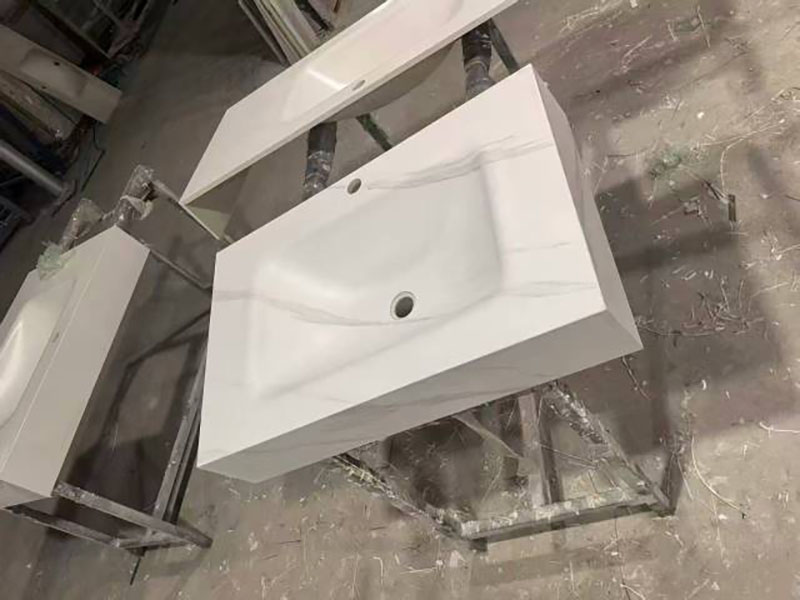
After cooling: calibration (diamond grinding to thickness), surfacing (polished, honed, textured, or velvet/satin), and cutting. Sintered stone is brittle — it needs diamond tooling; carbide blades wear out rapidly.
Quality Comparison
Based on publicly available industry data, the two ends of the market:
| Parameter | Low-End | Premium |
|---|---|---|
| Press force | <20,000 tons | ≥30,000 tons / ≥25 MPa |
| Sintering temperature | <1,000°C | ≥1,200°C |
| Water absorption | High (stains quickly) | Near-zero (<0.1%) |
| Mohs hardness | 5–6 | 6–7 |
| Density | Below standard | 2.3–2.8 g/cm³ |
| Fire rating | Lower | A1 (non-combustible) |
| Slab formats | ≤1200×2400 mm | Up to 1620×3240 mm |
Mid-range products sit between these extremes. There is no industry-wide grading system — this table represents general thresholds, not a formal classification. That's why independent testing matters.
How to Test Quality Yourself
1. The 24-Hour Stain Test
Apply soy sauce, red wine, or coffee to a sample. Cover. Wait 24 hours. Wipe with dry cloth, then water. Properly sintered: zero stain. Low-grade: visible stain remains.
2. The Scratch Test
Drag a metal key or utility knife (Mohs ~5.5) across the surface. Premium (Mohs 6–7): no scratch. Low-grade: visible mark or scratch.
3. The Heat Test
Place a hot pan directly on the sample. Quality sintered stone: no change. Low-grade: micro-cracks or discoloration.
4. The Weight Check
A 1200×2400×15mm slab should weigh approximately 100 kg. Two slabs of same dimensions with different weights = the lighter one has lower density and lower performance.
What to Ask Your Supplier
"What is your press force in metric tons and equivalent pressure in MPa for my slab format?"
"What is the peak sintering temperature? Can you share a Production Inspection Report?"
"What is the water absorption rate per ISO 10545-3?"
"What is the flexural strength per ISO 10545-4?"
"Can you ship a 10×10 cm sample for in-house testing before I commit to a container?"
A manufacturer that runs its own production line can answer all five. A trader or low-end factory stalls on questions 1 and 2 — they don't control the kiln. That pause tells you more than any catalog.
Why This Matters
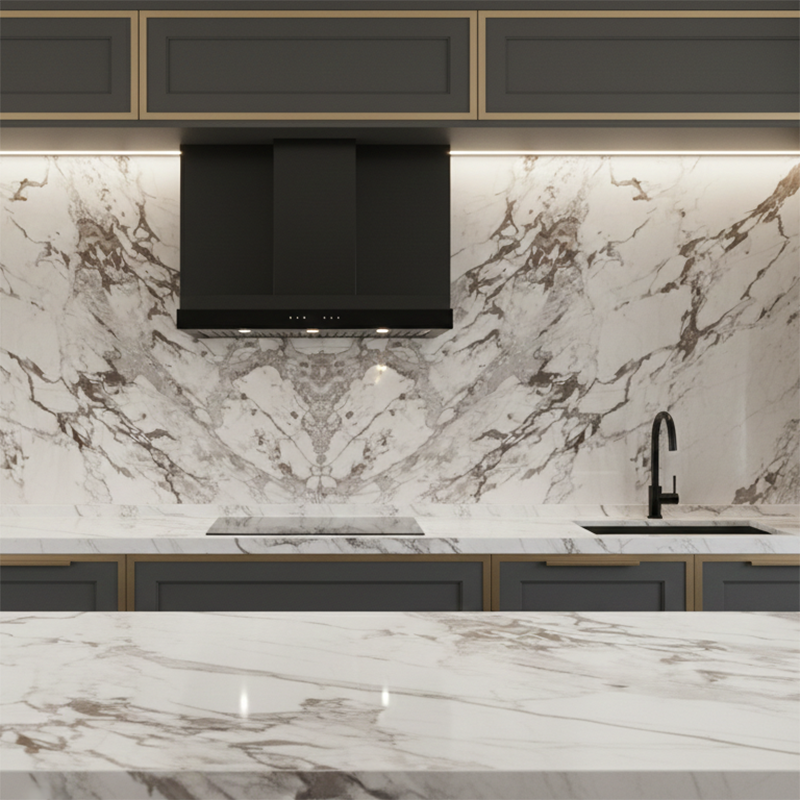
If you are specifying for a commercial kitchen, hospital lobby, or high-traffic hospitality project, the material either performs or it doesn't. A slab with measurable water absorption will stain — and once it stains post-installation, the replacement cost dwarfs whatever you saved on the material.
Manufacturers who invest in adequate press tonnage and 1,200°C+ kilns produce a product that genuinely competes with natural stone. Those who cut corners are selling something closer to ceramic tile. The only reliable way to know which you're buying is to test it.
Require our sintered stone collection — slabs in standard and jumbo formats, 12mm to 30mm, with Production Inspection Reports. Contact Yuanda Stone at info@yuandagroup.cn for samples and pricing.
Keywords: how sintered stone is made, sintered stone manufacturing, sintered stone quality, sintering temperature, press tonnage sintered slab, sintered stone stain test